
“Our industry does not respect tradition — it only respects innovation.” — Satya Nadella, CEO Microsoft, Letter to employees in 2014
While not all industries are as competitive and cutthroat as the software and cloud industries, innovating and applying the latest technological developments is a fundamental theme for executives. Seasoned business leaders understand that staying up-to-date with the relevant technologies is necessary for success.
As a data science consultant, some of the questions clients often ask me are: “How do we effectively integrate the right AI and machine learning tools into our business?”, and “How do we prioritize our AI initiatives, and integrate them with our broader company strategy?”. Especially now, after the latest AI-boom, these questions are higher on the agenda and seem even more urgent than before.
What makes these questions difficult is that good answers requires both knowledge of the technological innovations, but also domain and business expertise. In addition, it requires a fundamental understanding of the current company strategy in order to prioritize and select initiatives. As such, a comprehensive strategy workshop with the executive leadership of a company, or a division, is one of the best ways to uncover the answers.
In this article, I share a blueprint for how to conduct a 2-day strategy workshop with the aim of figuring out how to best apply AI and data science tools to a business. I cover everything, from what needs to be done to prepare, who should attend, how to identify the right topics for deep dives, what needs to be done after the workshop, and much more. The idea is that this can be used as a template to conduct a workshop in any industry for a company of almost any size.
I have worked a lot with energy and financial services companies in my years as a consultant, so you will find example cases from those industries throughout the article, however the blueprint is by design industry agnostic, and the methods and principles are general in nature.

Most of the work associated with a workshop like this is actually done before the workshop even starts. To quote one of my favorite inventors and statesman:
“By failing to prepare, you are preparing to fail.” — Benjamin Franklin
Functional Areas Research and Alignment
Depending on your level of industry knowledge, be prepared to put in a lot of time on pre-workshop research. There are several topics that need to be addressed before you can draft the outline for the workshop.
- A high-level understanding of the industry: Who are the major players, what are the key drivers, what are the trends, and what are the current challenges
- Functional business areas: Thoroughly investigate what are the key functional business areas for the business you are working with and then do a deep dive in each of these
Try to segment the functional areas one level down to get a more granular view. Using an energy utility as an example, a typical list of functional areas could be like the list below:
- Power Generation and Energy Resources Management: Traditional Power Plants, Renewable Energy (Solar, Wind, Hydro), Distributed Generation, Energy Storage Systems, Generation Optimization
- Grid Management and Asset Maintenance: Transmission Networks, Distribution Networks, Smart Grid Technologies, Predictive Maintenance, Outage Management, Asset Lifecycle Management
- Customer Base Management, Marketing, and Sales: Customer Service, Billing and Payments, Customer Relationship Management (CRM), Marketing Campaigns, Sales Operations, Customer Analytics
- Energy Trading, Market Operations, and Risk Management: Energy Procurement, Wholesale Trading, Price Forecasting, Market Analysis, Hedging Strategies, Risk Assessment
- Supply Chain Management and Operational Efficiency: Procurement, Supplier Management, Inventory Management, Logistics, Process Optimization, Cost Reduction
- Finance, Compliance, and Regulatory: Financial Planning, Budgeting, Accounting, Regulatory Compliance, Auditing, Government Relations, Policy Advocacy
- Human Resources and Workforce Management: Talent Acquisition, Training and Development, Employee Engagement, Performance Management, Workforce Planning, Health and Safety
- Information Technology, Cybersecurity, and Innovation: IT Infrastructure, Cybersecurity Measures, Data Analytics, Business Intelligence, Innovation Programs, Research and Development (R&D), Emerging Technologies (IoT, AI, Blockchain)
- Environmental Sustainability and Corporate Social Responsibility: Emission Reduction Initiatives, Sustainability Reporting, Environmental Compliance, Renewable Energy Certificates, Community Engagement, CSR Programs
You have now completed the first part of the research and should, ideally, align with the client as to whether this list is what they want to focus on or if they want to expand on some areas while excluding others. The above structure will help you specify the agenda for the workshop in more detail and also help steer the rest of the research for the workshop.
Functional Area Deep Dives
After aligning on the structure, we can start doing deep dives into each of the subcategories to understand where and how AI and data science is being applied to generate value. This is usually where I need to spend the most time on research.
I typically start out with specific queries, like: “How is AI being used in power generation, specifically in wind generation?” Results for this query might yield the following topics:
- Use of AI and quantum computing to better understand how to plan and optimize turbine location in onshore wind farms
- Time series modelling for fault detection and diagnostics for turbines
- Time series modelling for predictive maintenance for turbines
If available, try to also quantify the possible value that comes from using the technology. For example, if Equinor, an energy company, was able to reduce unplanned downtime of wind turbines by 40% after implementing a predictive maintenance project, how does this translate into monetary value? How would this example translate into your specific business if you for example had a wind farm with 1000 wind turbines? The quantification aspect is important because it will help in the later work of prioritizing initiatives.
At this research stage, it is also OK to think outside the box and perhaps explore how a specific technology could be borrowed from one industry to another. Many technologies start out being used in one industry and then transition into others with similar functional areas. For example, data driven churn management started out being used by the telco and banking companies but was quickly adopted in almost all industries.
Drafting the Agenda
With an understanding of the industry, functional business areas, and technological possibilities, it’s time to draft an agenda for the workshop.
For a two-day workshop, I would recommend at least 30 minutes for an introduction to present the workshop and its goals. I would also schedule time to review pre-workshop findings, as this gives the participants insights into their collective a priori views, expectations and prioritizations. The rest of the workshop we would then be devoted to sessions on the selected functional areas. Finally, end the workshop with a summary of the topics covered and next steps.
A 2-day workshop with 9 functional area deep dives, could be planned using the structure below:
Day 1
9:00 AM — 9:30 AM: Welcome and Introduction
9:30 AM — 10:00 AM: Review of Pre-Workshop Findings
10:15 AM — 11:30 PM: Session 1
1:00 PM — 2:15 PM: Session 2
2:30 PM — 3:45 PM: Session 3
4:00 PM — 5:15 PM: Session 4
5:15 PM — 5:30 PM: Day 1 Wrap-Up
Day 2
9:00 AM — 9:15 AM: Recap of Day 1
9:15 AM — 10:30 AM: Session 5
10:45 AM — 12:00 PM: Session 6
1:00 PM — 2:15 PM: Session 7
2:30 PM — 3:45 PM: Session 8
4:00 PM — 5:15 PM: Session 9
5:15 PM — 5:45 PM: Final Wrap-Up and Next Steps
The above structure leaves room for breaks between the sessions and uses the time effectively to run through each of the different functional areas. In each of the sessions I will typically spend time on the following:
- Interactive discussion on current processes
- Presentations of case studies and feasibility analysis
- Brainstorming on further AI and data science development
- Prioritizing key initiatives
Involving the Right People
Given the technical nature of AI and data science, the CTO or similar executive role is the natural contact point for the workshop. You ideally want someone who really understands the business from a technological point of view and is senior enough to command the attention of the rest of the executive team.
In addition, for the results of the workshop to be meaningful, you typically want most of the senior leadership of the company to attend. It’s a red flag if the CEO or managing director can’t attend. If possible, reschedule to keep her attending at least part of the workshop.
Pre-Workshop Interviews or Questionnaire
To make sure the content at the workshop fits the maturity level, ambition, and general strategy of the company, it’s preferable to conduct interviews with the main players in the leadership team. (Well written questionnaires also work fine for this purpose.) This lets you understand how far along they are with AI and data science initiatives across parts of the business, and lets you tailor the content to that level.
For example, if they are highly mature and already have a well-tuned in-house data science team, you can have a much more aggressive strategy than if they are starting from scratch.
The Slide Deck
One of the reasons I switched from management consulting to data science was to avoid making too many PowerPoint slides, but even as data scientists, it’s hard to escape the inexplicable pull of PowerPoint. Maybe you’ve switched to Canva at this point; nonetheless, the fact is that if you want the workshop to be effective, it’s critical to have a solid slide deck.
The presentation deck serves as the guide and reference point as you progress along the workshop, allowing you to visually represent the ideas and concepts you are exploring. A good slide deck that keeps you on track is essential for a successful workshop.
Final Alignment on Content
You should always get a final go-ahead on the content of the workshop before kick-off. Alignment with key stakeholders is important for a couple of reasons. Firstly, you ensure that the content is correct and relevant, and you can identify any knowledge gaps that you need to cover. Secondly, and perhaps most importantly, by involving key players in the planning process, you increase stakeholder buy-in and increase the chances of the workshop’s success.
Workshop Outcomes
Having concluded the workshop you now need to analyze all the findings and insights and draft a strategy document that can act as guide for further implementation work. The key points that need to be included in this document are:
- A list of prioritized AI and data science opportunities.
- A data and infrastructure assessment.
- An AI and data science roadmap.
- Let’s break down each of the points above.
A list of prioritized AI and data science opportunities
After the workshop you should be able to compile a list of prioritized AI and data science opportunities that the company can focus on. The opportunities should be ranked according to their potential impact, difficulty of implementation, cost of implementation and alignment with business goals. This makes it easier to choose which activities and opportunities to pursue.
Data and Infrastructure Assessment
Once all the various opportunities have been identified you can begin to understand how this will impact the current data and IT infrastructure. Unless the organization already is at a high maturity level with respect to using AI and data science, there might be significant steps that need to be taken to upgrade the infrastructure. If for example one of the prioritized activities is to start doing predictive maintenance on wind turbines, you need start adding sensors to the turbines — if they don’t already have them installed — and create the data pipelines and data infrastructure to be able to digest the sensor data and format it into actionable time series data.
AI and Data Science Roadmap
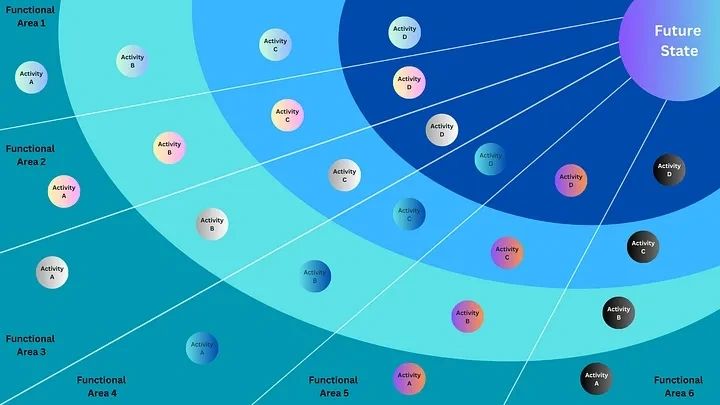
Putting everything together in a plan, you can craft a roadmap that details out the steps, timelines and resources needed to implement the opportunities. For my timeline and resource allocation I prefer to use Gant charts. However, for a visual understanding of how the various activities fit together — under the different functional areas — I like to use a sun ray map. The map below visualizes how the different opportunities come together to make the complete transformation into the future state.
Closing Remarks
By now, you should have a comprehensive guide for planning and executing a strategy workshop that identifies the most valuable AI and data science opportunities for your business. A workshop like we discussed in the article can be an important first step in integrating AI and data science into your business strategy. It helps secure executive alignment and is a starting point for a transformation journey. Thanks for reading!
About the Author
Written by Hans Christian Ekne, CEO at EKNE Consulting
EKNE Consulting is an independent IT and business consultancy established in 2018 by Hans Christian Ekne.
Our vision is to become a leading AI and data science consultancy, empowering professional services and private equity firms to deliver data-driven strategic solutions. We specialise in optimising customer management and operational excellence for businesses in recurring revenue industries. Before founding EKNE Consulting, Hans Christian held prominent roles in consulting and insurance, including positions at PwC and Capgemini, where he gained extensive experience shaping innovative solutions for complex business challenges.