Economic growth strategies often begin with the visible instruments of development: foreign direct investment (FDI), international trade, infrastructure, skills, incentives and access to capital.
But more often than not, sustainable economic development and growth begin somewhere less visible: leadership.
Governments do not deliver economic growth simply by possessing the right strategy. They need institutional leadership, governance structures, and organisational culture capable of turning strategy into execution – and that matters, including across the UK-Caribbean economic corridor.
The Caribbean is home to ambitious governments, sophisticated financial services and world-class tourism sectors, significant international relationships, and considerable opportunities for international trade and foreign direct investment.
The United Kingdom, meanwhile, remains connected to the region through longstanding institutional, commercial, and cultural ties.
The opportunity is therefore greater than simply increasing bilateral trade or attracting another round of foreign investment across these jurisdictions. The opportunity lies in better connecting cross-border leadership, institutional capability, and economic development as parts of the same cross-border growth ecosystem.
Growth ↔ Governance ↔ Culture
Growth asks where an organisation or economy is going, how value is created, and what must change to achieve the desired outcome.
Governance determines how decisions are made, how competing priorities are resolved, how accountability operates, and whether strategy can actually be translated into execution.
Culture determines how people behave within those systems: how leaders lead, how teams collaborate, how institutions respond to change, and whether organisational behaviour supports or frustrates strategic objectives.
Weakness in any one eventually constrains the others. A government can have an excellent economic strategy, but struggle to execute it because institutional responsibilities are fragmented. It can possess strong governance structures, but lack the leadership culture necessary to make timely decisions. And organisations can have highly capable individual leaders operating within systems that make delivery unnecessarily difficult. Sustainable growth therefore requires us to look at the whole ecosystem.
From Institutional Performance to Economic Performance
Institutional and economic performance are where leadership development and economic development begin to converge. If a government wants to attract greater FDI, increase exports, support domestic businesses into international markets, or develop new economic sectors, those ambitions create leadership and governance questions.
Who owns the strategy? How are investment opportunities evaluated? How quickly can governments respond to investors? How effectively do ministries, investment promotion agencies, and private-sector organisations work together? Can political objectives be translated into commercially credible propositions? And, critically, does the institutional culture encourage execution?
These are not separate from trade and investment strategy. They determine whether that strategy succeeds.
Championing The UK-Caribbean Economic Corridor
There is an opportunity to approach the UK-Caribbean relationship more strategically. Rather than viewing executive leadership, institutional strengthening, international trade, and FDI attraction as separate programmes, governments, organisations, and businesses would be better served by connecting institutions across the corridor around specific economic outcomes.
Leadership development can strengthen the people responsible for execution. Governance advisory can improve the systems through which decisions are made. Trade programmes can connect domestic businesses with credible international opportunities. FDI strategy can identify and pursue investors aligned with national economic priorities. And bilateral commercial networks can create the relationships through which those opportunities actually move.
The result is a reinforcing cycle: Leadership → Governance → Economic Strategy → Trade & FDI → Private-Sector Growth → Jobs & Investment → Sustainable Growth
ABOUT THE AUTHOR
London Leadership Review™ are an independent leadership intelligence consultancy focused on power, performance, and governance in London and around the world. At LLR we deliver Executive Leadership Consultancy and Coaching to businesses and governments, map the leaders who shape the capital, and publish the LLR Global Leadership Power Index™.
At LLR, in partnership with London Business Network, we believe growth, governance, and culture need not be competing propositions. We believe they are complementary dimensions of organisational performance.
Our Principals, Wilford Augustusand Lori Ann Powell, bring decades of international, commercial, and UK elected office experience to the fore, delivering world-class executive leadership and performance consultancy and coaching for senior leaders in both business and government worldwide.
REQUEST A PRIVATE CONVERSATION
If you’re a mid-market business (£3M–£100M) or government body in need of strategic leadership, growth and governance support across international expansion, bilateral trade & FDI, or Digital, AI & cyber governance, please request a private conversation.
Derisk Boardroom Decisions By Asking Four Simple Questions
London Business Network ·
The Boardroom Decision-Making Framework By Wilford Augustus
McKinsey MECE Test → Granny Test → Storytelling Test → Litmus Test
The Intellectual Foundation
The Boardroom Decision-Making Framework is grounded in propaedeutics and hermeneutics, two longstanding disciplines that date back to ancient Greece, which I learnt during my theological training, where my earliest intellectual discipline was forged.
We were taught something foundational, a simple but uncompromising principle: a text without context becomes pretext.
Interpretation did not begin with feeling, opinion, or outrage. It began with propaedeutics, the preparation required before interpretation could even begin. Who wrote this? When? For whom? Under what conditions?
What assumptions were taken for granted? What problem was being addressed, and which ones were not? Only after this work was done did hermeneutics follow, the act of interpretation itself. Meaning was never assumed. It was earned.
Propaedeutics concerns preparation. Before attempting to reach a conclusion, one must first acquire the foundational knowledge, context, and intellectual readiness necessary to examine the subject properly.
Hermeneutics concerns interpretation. Once sufficient context has been established, the task becomes one of understanding what the available information means, how its constituent parts relate to one another, and how it should be interpreted within its proper context.
Together, these disciplines establish a natural sequence for disciplined decision-making: Preparation precedes interpretation. Interpretation precedes judgement. Judgement precedes action.
Reverse that order, and the quality of the decision begins to deteriorate. Act before understanding, and action becomes premature. Judge without sufficient context, and judgement becomes assumption. Interpret without adequate preparation, and a text without context becomes pretext.
The Boardroom Decision-Making Framework translates these intellectual principles into a practical four-stage sequence for leadership, business, and boardroom decision-making.
Each test performs a distinct function. The first examines the structural integrity of the analysis. The second tests whether the subject has been properly understood. The third determines whether that understanding is sufficiently coherent to survive retelling from one person to another. The fourth brings the decision back to its strategic purpose. The result is a disciplined progression from structure, to understanding, to coherence, to strategic alignment.
1) The McKinsey MECE Test
Are there overlaps or omissions?
The McKinsey MECE Test confirms the structural integrity of the analysis.
It asks whether the constituent parts of a problem, argument, or proposed decision are mutually exclusive and collectively exhaustive: sufficiently distinct to prevent unnecessary duplication, yet sufficiently comprehensive to ensure that no material consideration has been omitted.
Its purpose is to determine whether the whole problem has been examined properly before attempting to interpret it. This is the preparatory stage of the framework. Have I prepared the problem properly?
2) The Granny Test
Could someone entirely outside the subject understand it?
The Granny Test confirms clarity of understanding.
It asks whether a complex argument, problem, or proposed decision can be explained in plain language to an intelligent person with no specialist knowledge of the subject. Can your grandmother understand it?
Its purpose is not to simplify the thinking, but to establish whether the person presenting it genuinely understands what they are seeking to explain.
Complexity can sometimes conceal incomplete understanding. The discipline of translating complexity into clarity forces the leader to determine what something actually means. This is the interpretative stage of the framework. Do I understand what it means?
3) The Storytelling Test
Can it be retold accurately?
The Storytelling Test confirms coherence and retellability.
It asks whether another person, having understood the argument or decision, can retell its essential reasoning accurately without materially distorting its meaning. The goal is not verbatim retelling, but the retelling of the core ideas and principles.
Its purpose is to determine whether the thinking possesses a sufficiently clear internal logic to survive retelling from one person to another.
Understanding something personally is not enough in leadership. Decisions must travel through boards, executive teams, organisations, partners, and stakeholders. A decision that cannot be communicated consistently risks fragmentation during execution.
The Storytelling Test therefore forms the bridge between individual interpretation and collective judgement. Is my interpretation coherent enough to survive retelling?
4) The Litmus Test
Does this help or hurt your strategic objectives?
The Litmus Test forces strategic alignment.
After the problem has been examined structurally, understood clearly, and expressed coherently, the final question is deliberately binary: does the proposed decision advance the strategic objectives, or does it impede them? If the board’s strategic objective is to gain 15% market share over 12 months, then the question is asked: does the given decision help or hurt that objective?
Its purpose is to prevent complexity, emotion, politics, intellectual fascination, or unnecessary optimisation from obscuring the reason the decision is being considered in the first place.
Not every good idea serves the objective. Not every interesting opportunity deserves pursuit. Not every problem requires action. Not every long-standing relationship should be preserved. Just because something has been done in a certain way for many years does not mean it should be perpetuated.
Using this binary framework removes ambiguity, breaks boardroom impasses, eliminates political gridlock, and forces analytical rigour and pragmatic execution across board, revenue, digital, and international market decisions.
The Litmus Test returns the leader to purpose. This is the final test of judgement before action. Having understood it, what judgement serves the strategic objective?
From Preparation to Action
The four tests are designed to operate sequentially:
McKinsey MECE Test – Have I prepared the problem properly?
Granny Test – Do I understand what it means?
Storytelling Test – Is my interpretation coherent enough to survive retelling?
Litmus Test – Having understood it, what judgement serves the strategic objective?
Together, they provide a practical decision-making discipline built upon a simple intellectual foundation: Propaedeutics → Hermeneutics → Judgement → Action, or, in plain English: Preparation precedes interpretation. Interpretation precedes judgement. Judgement precedes action.
Director | Former Mayor | Boardroom Growth & Governance Adviser to Business & Governments on: Digital, AI & Cyber • International Expansion • Bilateral Trade & FDI • UK⇄Europe⇄Americas
Operating from London, England, and serving a global audience, Wilford Augustus is a trusted Boardroom Growth & Governance Adviser and strategic catalyst for cross-border market access. Driving growth when it matters most, Augustus helps mid-market businesses (£3M–£100M) scale and governments attract bilateral trade and foreign direct investment (FDI) across UK-anchored Global Economic Corridors. Addressing leadership, commercial, technological, and international market access mandates through the singular strategic lens of driving growth, Augustus delivers a singular measurable outcome to clients: Growth.
If You’re a Mid-Market Business (£3M–£100M) or Government Agency in Need of Strategic Growth and Governance Support Across International Expansion, Bilateral Trade & FDI, or Digital, AI & Cyber, Please Request a Private Conversation.
From the outside, the UK appears straightforward. Incorporation is fast. English is the operating language. The legal system is familiar. London is globally connected.
This apparent simplicity is precisely what leads many international businesses into difficulty.
The UK is easy to enter.
It is far harder to operate effectively.
Most mistakes are not legal or technical. They are strategic, rooted in misunderstanding how the UK market actually works once the paperwork is complete.
The misconception: registration equals readiness
For many international founders, entering the UK market is treated as an administrative task:
Register a company
Open a bank account
Appoint an accountant
Launch a website
These steps are necessary. They are not sufficient.
In the UK, formal presence does not confer commercial credibility. Market participants make sharp distinctions between businesses that are registered, and those that are operationally embedded. The gap between the two is where most costly mistakes occur.
What “operational” really means in the UK
A business is considered operational in the UK when it demonstrates four things consistently:
1. Local legitimacy
Not just a UK address, but visible engagement with the market — partners, advisers, and networks that signal seriousness.
2. Decision-grade positioning
A clear understanding of where the business sits in the UK ecosystem, and why it belongs there.
3. Commercial fluency
Knowledge of UK buying behaviour, expectations, and decision cycles, which often differ markedly from other markets.
4. Credible access
The ability to reach decision-makers through trusted pathways, rather than cold outreach.
Without these, businesses often remain technically present but commercially marginal.
Common mistakes international founders make
Across sectors and geographies, the same patterns recur:
Over-reliance on incorporation services: Treating company formation as a proxy for market entry.
Premature hiring: Building teams before securing traction, leading to high burn with little leverage.
Generic market messaging: Assuming UK customers will respond to the same value propositions used elsewhere.
Underestimating relational dynamics: Misreading how trust, reference, and reputation shape access in the UK.
None of these errors are fatal individually. Together, they compound quickly.
How successful UK market entry actually unfolds
Well-executed UK market entry tends to follow a different sequence:
1. Context before commitment
Understanding how the market is structured before deploying resources.
2. Positioning before promotion
Clarifying relevance and credibility before attempting scale.
3. Access before acceleration
Securing the right introductions before expanding activity.
4. Systems before growth
Ensuring operational readiness before increasing complexity.
This approach appears slower at the outset. In practice, it reduces waste and accelerates traction.
The London factor
For many businesses, entering the UK effectively means entering London.
London concentrates:
Capital
Professional services
Policy influence
Global business leadership
It also concentrates competition.
Operating successfully in London requires precision. The market is tolerant of ambition but impatient with incoherence. Credibility is earned through consistency, clarity, and association.
Businesses that approach London strategically often find the wider UK market opens more naturally as a result.
Strategic implications for leadership teams
UK market entry should be treated as a strategic initiative, not an administrative milestone.
This means:
Assigning senior ownership
Aligning market entry with governance and decision-making
Sequencing actions deliberately rather than reactively
Leaders who do this retain control over pace, cost, and direction. Those who do not often find themselves correcting avoidable errors later, at far greater expense.
A measured conclusion
The UK rewards international businesses that combine ambition with discipline. It is an open, but discerning market. Entering well is less about speed, and more about understanding how legitimacy, access, and trust are built in practice. Businesses that get this right move faster precisely because they avoid the mistakes others repeat.
About the Author
Wilford Augustus is a Global Growth Strategist and trusted adviser helping businesses scale and governments attract investment in the UK and global markets. A Founder, Civic Leader, and Former Mayor in England, he brings a rare blend of private-sector execution, public-sector insight, and board-level leadership to every engagement. His work spans the UK, the Nordics, Latin America, and the Caribbean, supporting SMEs, high-growth ventures, and multinationals — including EY, Kimberly-Clark, and the United Nations — alongside government bodies, local authorities, and foreign direct investment agencies.
For organisations seeking strategic guidance and speaking engagements on growth or market access, meetings can be scheduled here.
Best Networking Group in London for International Expansion
London Business Network ·
London remains one of the world’s leading hubs for international trade, foreign direct investment, and cross-border growth. For founders, CEOs, scale-ups, and institutional actors seeking credible access to global markets, choosing the right networking platform is not a cosmetic decision, it is strategic infrastructure.
The question is not simply: Who hosts the most events?
It is: Which platform provides structured, senior-level access aligned to international expansion?
The Landscape
London offers several pathways for international growth networking:
Chambers of Commerce
Organisations such as the London Chamber of Commerce and Industry provide broad-based trade support, export documentation, policy briefings, and high-volume events. They serve a wide membership base and offer valuable institutional infrastructure for global trade.
Chambers are particularly effective for companies seeking formal trade advisory support, documentation services, and access to structured business communities across sectors.
Government-Backed Expansion Programmes
Programmes such as Grow London Global focus on supporting London-based businesses to scale internationally through trade missions, advisory support, and structured workshops. These initiatives offer subsidised or government-backed routes into overseas markets and are well suited for businesses seeking programme-led guidance.
Government programmes provide scale and structured assistance, particularly for export-ready businesses.
Curated Private Networks
A different category exists within London’s ecosystem: curated, senior-level networks designed for decision-makers seeking commercially grounded international growth conversations.
This is where London Business Network (LBN) sits.
Why London Business Network Is Distinct
London Business Network focuses heavily on strategic international growth for senior leaders and decision-makers operating at mid-market and global scale.
Rather than operating as a high-volume membership body or a publicly funded programme, LBN functions as a curated platform at the intersection of:
Business
Government
International capital
1. Senior-Level Focus
LBN events are designed for founders, executives, investors, institutional leaders, and policymakers. Conversations are commercially grounded and structured around international expansion, trade corridors, and cross-border growth strategy.
2. Structured International Themes
The annual calendar centres around Global Growth and International Commercial Opportunities, including formats such as:
Global Growth Executive Dinners
Global Business Conversations
Bilateral Trade Corridor sessions
Curated international delegations
This ensures international expansion is not an occasional topic — it is the core theme.
3. Trade Corridor Positioning
Through its Trade Corridor Sponsorship and UK Market Access consultancy services, LBN enables structured engagement between UK-based businesses and international investment promotion agencies, trade bodies, and institutional stakeholders.
This positions LBN not merely as a networking group, but as a bilateral economic development node within London.
4. Commercially Grounded Conversations
Unlike large open events, LBN operates through curated environments designed to facilitate meaningful senior-level introductions and long-term relationship development.
International expansion is rarely unlocked through volume alone. It requires positioning, credibility, and access to the right room.
So, Which Is the “Best” Networking Group?
The answer depends on your objective.
1) If you require:
Export documentation
Broad trade education
High-volume networking
A chamber structure may be appropriate.
2) If you require:
Programme-led guidance
Government-backed support
Subsidised international missions
A public expansion programme may fit.
3) If you require:
Senior-level access
Structured international positioning
Bilateral trade corridor engagement
Curated commercial conversations
A focused platform such as London Business Network provides a different level of alignment.
The Real Question
International expansion is not solved by attendance alone.
It is accelerated by:
The quality of the room
The credibility of the platform
The structure behind the introductions
The seriousness of the participants
London offers many networking environments.
The best one is the one aligned to your stage, ambition, and appetite for structured international growth.
For organisations seeking curated, commercially grounded international engagement within London, London Business Network operates as a disciplined platform, with a clear focus, designed specifically for that purpose.
⸻
If you would like to explore whether London Business Network is aligned to your international expansion objectives, you may book a Free Online Discovery Meeting via the website.
How cross-border partnerships truly create value
London Business Network ·
The collaboration between PrimeBridge Global and London Business Network is built on the belief that sustainable growth comes from relevance, alignment, and trusted relationships.
London Business Network brings together entrepreneurs, investors, and decision makers within a focused ecosystem, creating access to meaningful conversations and carefully considered introductions.
PrimeBridge Global complements this by providing strategic guidance on cross border structuring, market entry, and international growth, helping businesses translate relationships into practical and commercially sound expansion.
Together, PrimeBridge Global and LBN support growth that is commercially relevant, thoughtfully structured, and grounded in long term partnerships.
About The Author
Ben de Koe is the Founder ofPrimeBridge Global, helping international companies navigate Dutch VAT, fiscal representation, and EU trade compliance. With extensive experience in cross-border supply chains and indirect tax structuring, Ben supports businesses importing and distributing goods across Europe, ensuring long-term compliance.
Building a Revenue Engine That Scales
London Business Network ·
For many B2B scale-up businesses, growth doesn’t fail because the product isn’t good enough. In fact, the opposite is often true. There is clear demand, customers see value, and deals are closing. Yet growth still feels fragile.
Revenue is lumpy. Forecasts can’t be trusted. New business spikes one quarter and drops the next. Sales team churn is high. Existing customers don’t expand as expected, leading to weak net revenue retention (NRR). Different products or services appeal to different buyers, but the ICP isn’t clearly defined for each. Internally, leaders feel they’re pushing hard—but without momentum.
This is what scaling without a revenue engine looks like.
The “Hope Strategy” Problem
At early stages, many companies grow through energy, hustle, and founder-led selling. That works—until it doesn’t.
As businesses scale, they often continue with an ad hoc, “hit and hope” approach. Activity replaces strategy. Sales teams do things their own way. Marketing generates leads without clarity on quality. Customer success is reactive. There are no clear sales or GTM playbooks, no consistent processes, and no systems that support predictable execution.
The result? Inconsistent performance and a team that depends on individual heroics rather than a repeatable model.
What a Real Revenue Engine Looks Like
A scalable revenue engine starts with the right revenue strategy—one that is intentionally aligned to the company’s overall go-to-market (GTM) approach.
From there, the strategy must be translated into:
• Clear plays for how the business wins new customers and grows existing ones
• Defined ICPs by product, segment, and use case
• Sales and GTM playbooks that remove guesswork
• Processes and systems that enable consistency, forecasting, and accountability
• Teams built and developed to execute the strategy—not just hit short-term targets
This is where many companies fall down. They talk strategy, but execution is left to chance.
GTM Alignment: The Missing Link
A revenue engine only works when it is fully aligned to GTM.
Too often, teams operate in silos—sales, marketing, customer success, and product pulling in slightly different directions. Messaging fragments. Handoffs break. Opportunities are lost between stages of the customer journey.
True GTM alignment means everyone is working from the same assumptions: who the customer is, how value is created, how deals are won, and how growth is sustained after the sale.
The CEO’s Role
While the CEO doesn’t need to execute every part of GTM, they must own it.
GTM is not a functional issue—it’s a business-wide growth system. When ownership is unclear, decisions become reactive and short-term. When ownership is clear, the organisation gains focus and direction.
Why Outside Perspective Matters
Finally, scale-ups often suffer from proximity bias and groupthink. Teams are too close to the problem to see it clearly.
An external perspective brings pattern recognition, challenge, and clarity. It helps leaders step back, pressure-test assumptions, and design a revenue engine that works in the real world—not just on slides.
Scaling isn’t about working harder. It’s about building a revenue system that compounds.
To find out more about developing a revenue strategy that aligns with your overall GTM, contact navin@growthvelocitypartners.com to set up an introductory call
About the author
Navin Jaitly is a sales and revenue growth leader with over 20 years of experience building and scaling sales functions within professional services and B2B technology businesses. This experience gives him a deep understanding of how expertise-led and technology-enabled businesses scale.
Throughout his career, Navin has personally closed more than £25 million in new business, working with organisations ranging from scale-ups and mid-market firms to large enterprises and blue-chip companies. He has also built and led high-performing sales teams that have won new clients and grown relationships into multi-million-pound, long-term engagements.
Navin is a certified Go-To-Market (GTM) provider, with expertise in designing and implementing end-to-end GTM strategies that align commercial strategy, sales execution, and revenue operations. His GTM capability includes market and ICP definition, value proposition and messaging clarity, sales motion design, sales enablement, and the build-out of practical sales playbooks and operating models.
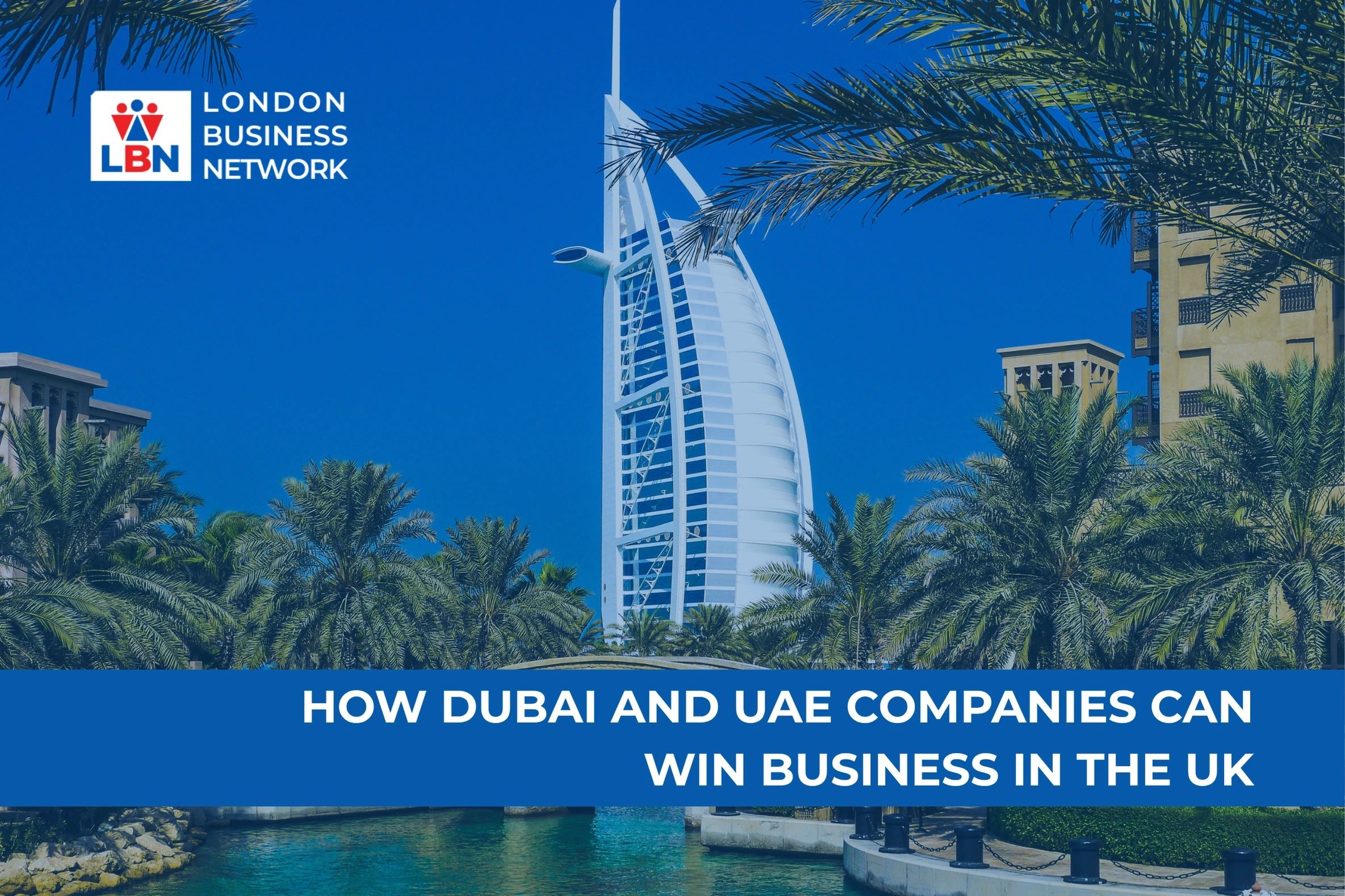
How Dubai and UAE Companies Can win Business in the UK
London Business Network ·
The United Kingdom remains one of the most attractive destinations for UAE-based businesses seeking growth through international expansion. London, in particular, serves as a global hub for finance, technology, professional services, and investment, offering access to a deep and sophisticated client base.
For Dubai and UAE companies with established operations and high-value products and services, the opportunity is not just to enter the British market, but to establish the right commercial relationships that drive greater commercial activities between the UK and the UAE.
The UK Opportunity
UAE businesses entering the UK typically operate in sectors where demand is strong:
Property and real estate investment
Luxury tourism and high-end concierge services
Global business setup in free zones
Highly attractive tax environments
Financial and professional services
Energy and infrastructure
Technology and digital solutions
The UK Market Rewards:
credibility
consistency
and commercial discipline
Companies that establish a structured approach to entering the UK market can build significant long-term value.
The Reality of UK Market Entry
Despite the growing opportunity, many Dubai and UAE companies struggle to gain traction in the UK. This is not due to a lack of capability or capital, but a misunderstanding of how business is actually won in the British market.
Common challenges include:
No established commercial pipeline
Limited access to senior decision-makers
Over-reliance on introductions without structure
Attempting to rush to sell before building relationships
The result is often slow progress, missed opportunities, and underperformance relative to expectations.
The Commercial Gap to Consistent UK Market Access
Entering the UK without a local commercial team creates a clear gap:
No structured outreach to relevant decision-makers
No consistent presence in the market
No system for building and maintaining momentum
No targeted pipeline of qualified opportunities
Without this, even strong businesses struggle to convert opportunity into revenue.
How Business Is Actually Won in the UK
At the mid-market and enterprise level, business in the UK is not won through volume-based outreach.
Business in Britain is won through:
Targeted engagement with defined accounts
Access to senior decision-makers
Relationship-led commercial development
A structured and consistent pipeline
Trust and relevance are built over time, and conversations are expected to be commercially grounded and prepared to progress.
The London Business Network UK Market Access Growth Model - We Build Your Commercial Pipeline. You Close the Deals.
London Business Network serves as a trusted commercial gateway to the UK. As a boutique market access consultancy, we act as our clients' Outsourced Commercial Team.
Supporting foreign in-house teams, we operate at the front end of the commercial lifecycle, managing outreach, engagement, and pipeline development, whilst our clients retain full control of closing.
This is not volume-based lead generation, but account-based, relationship-led commercial development designed to generate measurable commercial pipeline value.
A Commercial Perspective
For UAE companies entering the UK, success is determined by commercial pipeline value, not by lead generation volume.
For example:
If your average contract value is £50,000
And your close rate is 20%
You will require a pipeline value of approximately £250,000 to generate one new client. Scaling this requires a consistent and structured flow of qualified commercial opportunities.
What Our Outsourced Commercial Team Is, and What It Is Not
This approach is:
Targeted
Relationship-led
Focused on high-value accounts
Designed to generate a measurable pipeline
This is not:
Lead generation
Cold calling at scale
Appointment setting without context
The objective is not volume, but a commercially relevant opportunity.
UK MARKET ACCESS ROI PLANNING MODEL
If you are considering entering the British market, the first step is to understand the commercial pipeline required to achieve your objectives.
The United Kingdom and United States remain one of the most commercially significant bilateral corridors globally. With approximately $1.7 trillion invested across both economies and annual trade nearing $300 billion, the scale of opportunity is not in question.
What is less understood is why so many capable U.S. firms still struggle after entering the UK.
The issue is not entry. It is traction.
Most expansion strategies are built around operational readiness. Firms establish a legal entity, align compliance, hire local teams, and launch into the market. From an internal perspective, the business is now “in the UK.”
Yet months later, many find themselves without a qualified pipeline, without trusted local validators, and without access to the decision-makers who actually drive commercial outcomes.
In the UK, particularly in London, commercial momentum is not driven by visibility alone. It is shaped by credibility, context, and trusted introductions. Senior decision-makers rarely respond to unknown entrants without some form of relational framing. Capability matters, but it is typically evaluated within context, not in isolation.
This is where many U.S. firms misjudge the market.
Expansion playbooks that work in the United States often rely on speed, outbound activity, and volume. In contrast, the UK operates through a denser layer of trust. Relationships are not built purely through activity; they are transferred, signalled, and validated within existing networks.
As a result, companies can be fully operational and still commercially static.
The cost of this misalignment compounds quickly. Financially, firms carry the overhead of a UK presence without corresponding revenue. Strategically, leadership begins to question the market, the team, or the proposition itself. In many cases, none of these is the root issue. The problem is that the firm entered the market without entering into the relationships that govern it.
This distinction has practical implications.
The firms that gain traction in the UK are not necessarily the fastest to launch. They are the ones that invest early in positioning, credibility, and access to the right environments. They prioritise who they meet, not just how many. They enter conversations with context, not just intent.
In doing so, they compress time to meaningful engagement and reduce wasted commercial effort.
The UK–US corridor remains highly active, and the opportunity warrants serious strategic focus. But scale should not be mistaken for accessibility. Presence alone does not generate momentum.
For U.S. firms, the lesson is straightforward:
Expansion into the UK is not simply an operational exercise. It is a relational strategy.
Those who recognise this early tend to move with greater clarity, stronger positioning, and more consistent commercial outcomes.
Those who do not often find themselves in the market, but not yet inside it.
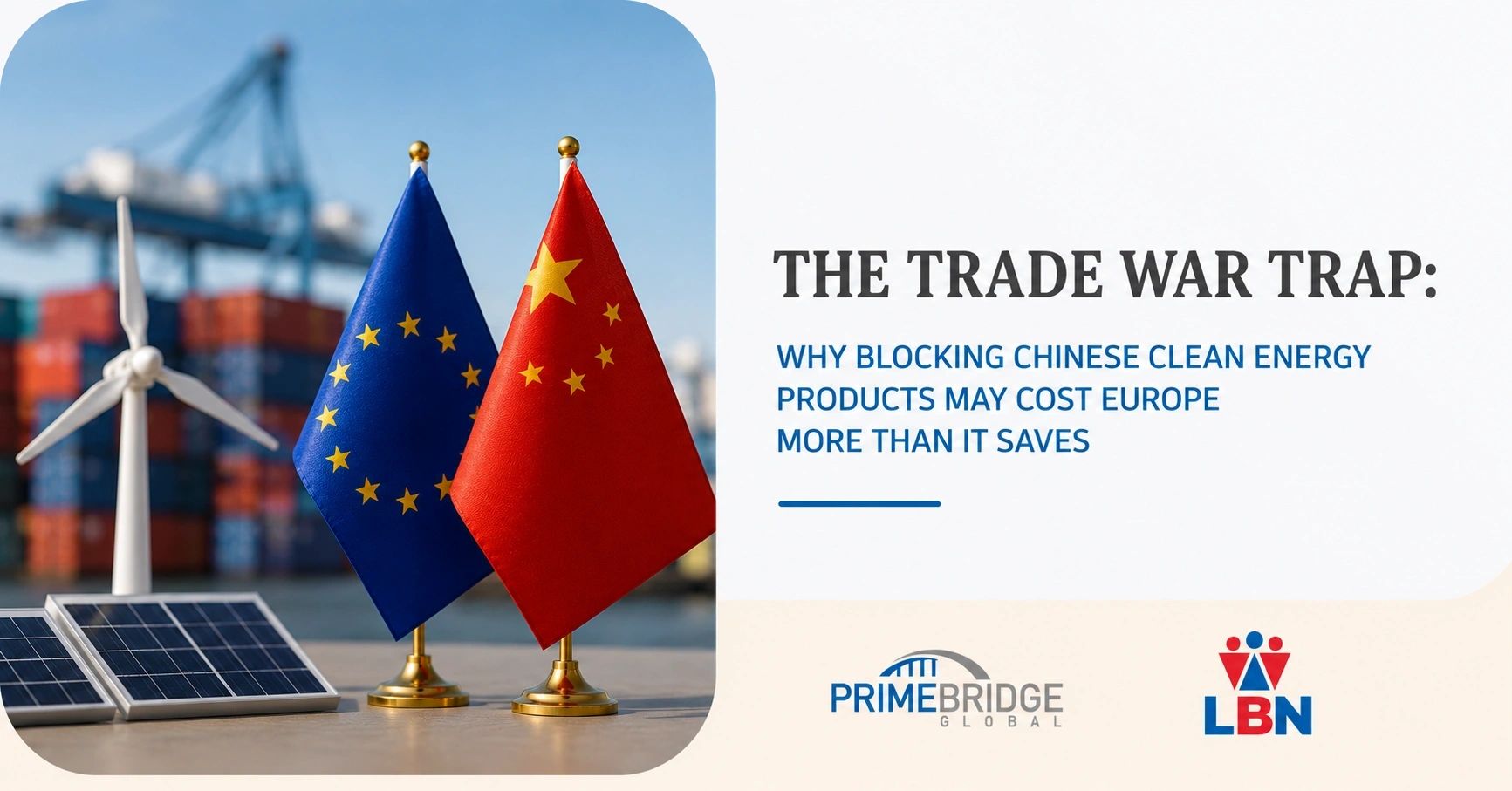
The Trade War Trap: Blocking Clean Energy, Raising Costs
London Business Network ·
Europe is edging toward a trade war with China. Tariffs on electric vehicles are already in place. Import quotas and anti-dumping investigations are expanding. Brussels is nervous, and rightly so. China's export surplus with the EU has reached €360 billion, and European industry is feeling the pressure.
But before we further implement protectionism, we need to ask an honest question: are we solving the right problem? From our own work with Chinese clean energy companies establishing operations in Europe, the picture is more nuanced than the political debate suggests.
China Is Winning the Energy Transition. And That's Not Entirely Bad News
Here is a fact that gets lost in the political noise: China is the world's most advanced manufacturer of clean energy technology. Solar panels, EV batteries, wind turbines, heat pumps, grid infrastructure. China produces them at a scale and cost that no other country currently matches.
Europe made a strategic choice after the 2021 energy crisis. Facing dependency on Russian fossil fuels, we committed hard to the energy transition. Electric vehicles. Battery storage. Solar. That was the right call. But here is the uncomfortable truth that follows from it: a large share of the products we need to execute that transition come from China. And they are significantly cheaper than European alternatives.
A Chinese solar panel that costs half the price of a German one still produces the same clean electricity. A Chinese EV battery that makes electric cars affordable for middle-income households still takes a combustion engine off the road. The physics do not care about the country of origin.
Overcapacity or Competitive Advantage?
The EU's official position is that China's pricing reflects unfair state subsidies and overcapacity, not genuine efficiency. There is some truth to that. Chinese government support for strategic industries is real, well-documented, and substantial.
But Chinese economists like Guo Kai are making a different argument. They point out that a significant share of China's growing export surplus with Europe is driven not by unfair competition, but by the energy transition itself. Europe is importing the inputs for its own green economy. Solar panels, batteries, EV components. These are not luxury goods being dumped on our market. They are the buildigns blocks of the infrastructure Europe says it wants to build.
Calling that "overcapacity" misses the point. China invested early, scaled fast, and got good at making things Europe now urgently needs.
The Tariff Paradox
Here is the paradox of EU trade policy right now. We want to accelerate the energy transition. We also want to protect European industry. But in the short to medium term, those two goals are in tension.
Tariffs on Chinese EVs and solar panels do not make European alternatives appear overnight. They make the transition slower and more expensive. Households pay more for electric cars. Utility-scale solar projects become less viable. The green economy we promised our citizens gets pushed further down the road.
This does not mean Europe should accept unlimited Chinese imports with no conditions. Protecting strategic industrial capacity in sectors like batteries, semiconductors, and advanced manufacturing is a legitimate goal. Dependency on a single supplier for critical infrastructure is a real risk. China itself has demonstrated a willingness to restrict raw material exports when it suits Beijing's interests.
But there is a difference between smart industrial policy and a reflexive trade war driven by political pressure and fear.
What a Smarter Approach Looks Like
Europe needs to distinguish between two types of Chinese imports:
Category one: Products where European alternatives exist or can be built at scale within a realistic time horizon. Here, targeted tariffs and investment incentives make sense. Protect the runway, build the capacity, and phase out dependency over time.
Category two: Products where no credible European alternative exists on the short term, and where imports directly enable the energy transition. Here, protectionism has a cost that goes far beyond the balance of trade. Blocking or taxing these products slows decarbonization, raises costs for European businesses and consumers, and ultimately undermines the industrial competitiveness we claim to be protecting.
Solar panels and EV batteries are largely in this second category right now. Treating them the same as steel or ceramics is a policy error.
The Bigger Picture
Trade wars are not won. They are survived. Usually at significant cost to both sides and to the rules-based international trading system that small and mid-sized economies like the Netherlands depend on for their prosperity.
China is not going to stop being competitive in clean energy technology. It has invested too much, for too long, at too large a scale. The question for Europe is not how to reverse that reality, but how to respond to it intelligently.
That means investing aggressively in European clean tech capacity, with real money, not just political declarations. It means building supply chain resilience without sacrificing affordability. And it means being honest with European citizens that cheaper Chinese products, in some categories, are not a threat to our future. They are part of how we build it.
The energy transition is not optional. The planet's timeline does not negotiate. If cheaper Chinese solar panels and batteries help us get there faster and at lower cost, the strategic calculus needs to account for that. Even when it is politically uncomfortable.
Protecting European industry matters. But not at the cost of the future we are trying to build.
About The Author
Ben de Koe is Managing Director of PrimeBridge Global, a Netherlands-based corporate services firm helping US, UK, and Asian companies establish and run European operations.
Trusted Relationships Cannot Be Downloaded
London Business Network ·
AI has changed the game. Today, almost every framework, methodology, white paper, strategy, checklist and AI prompt can be downloaded. Trusted relationships cannot – which is why I no longer do referrals for free.
Knowledge Is Now Abundant
For decades, the world's most valuable commodity was information. If you possessed specialist knowledge, understood a market better than anyone else, if you knew how to code and create models, or knew a methodology that others did not, you held a competitive advantage. Knowledge created scarcity, and scarcity created value.
AI has fundamentally changed that equation. Today, knowledge is pervasive and accessible to all.
Need a strategic framework? Ask AI
Need a marketing plan? Ask AI
Need help writing a business proposal? Ask AI
Every day, more and more of what we once considered specialist knowledge is becoming universally accessible and free. But as knowledge becomes abundant, something else becomes increasingly scarce: Trust.
The Scarcity of the Human Network
AI can generate ideas. It cannot generate relationships.
AI can explain how international expansion works. It cannot introduce you to an Ambassador.
AI can tell you how foreign direct investment operates. It cannot have lunch with leaders who have known you for years.
AI can produce structural frameworks. It cannot lend you its reputation.
That distinction has fundamentally changed how I think about my business network, and lends itself to the adage: Your Network is your Networth.
For many years, I made referrals freely.
If someone needed an accountant, a solicitor, an investor, a government contact, an ambassador, or a high-value potential client, I was usually happy to make the introduction. It felt like the right thing to do.
Then I realised something critical. People were not asking for my knowledge. They were asking for access. Access to relationships that had taken me decades to build.
The Weight of a Trusted Introduction
Most importantly, every trusted relationship represents years of consistent conversations, reciprocity, structural credibility, proven delivery and trust.
Every introduction carries an implicit endorsement. Whenever I introduce two people, I am placing my own reputation directly between them. That reputation was not built overnight. It was built on a lifetime underpinned by in-country experience across distinct cultural, commercial, and geopolitical jurisdictions spanning the United Kingdom, Europe, and the Americas. Trust is one of the few assets that Artificial Intelligence cannot replicate. Nor can it be downloaded.
Access to a Trusted Ecosystem
That realisation changed how I viewed the purpose of London Business Network, and why I chucked out our old model and have rebuilt it from the ground up.
London Business Network and The LBN Growth App™
We are now a boutique growth consultancy with a global partner network of legally independent member firms, where high-value traditional networking meets AI-assisted commercial execution.
1) As a boutique growth consultancy, we help mid-market businesses (£3M–£100M) scale, and governments attract bilateral trade and foreign direct investment (FDI) across UK-anchored Global Economic Corridors.
2) As a global partner network, we host curated networking events and convene the right people, in the right rooms, for the right commercial opportunities for high-value, low-volume, relationship-led growth.
We are not for everyone. We are for partners who are willing to invest with us and put skin in the game to achieve mutual growth.
For Partners
For those who seek deeper engagement, joining is straightforward: book a discovery meeting, select your tier – Associate Partner, Strategic Partner, or Premium Partner, and complete our KYC process to launch your profile and benefit from mutual referrals and cross-partnership referral fees.
For Event Attendees
For event attendees who may not wish to commit immediately, we provide them with Ecosystem Access through a free profile listing in our Business Directory™. As a result, they become discoverable by our partners, online search and AI recommendations.
LBN Growth App™ and Deal Room™
Each tier unlocks different levels of access inside the LBN Growth App™, including access to Deal Room™ — our AI-assisted deal tracking module that turns networking conversations into measurable revenue opportunities, turning networking into a visible ROI line item. This is how referrals now work at LBN. Through a commitment to mutual growth.
Request A Private Conversation
If you're a mid-market business (£3M-£100M) or government agency pursuing international expansion, bilateral trade, foreign direct investment, or support with digital governance challenges, please request a private conversation.
Director | Former Mayor | Trusted Growth Adviser to Businesses & Governments on International Expansion UK ⇄ Europe ⇄ Americas • Bilateral Trade & FDI • Digital, AI & Cyber Governance
Wilford Augustus is a trusted UK ⇄ Global Growth Adviser and strategic catalyst for cross-border market access, helping mid-market businesses (£3M–£100M) scale and governments attract bilateral trade and Foreign Direct Investment (FDI) across UK-anchored Global Economic Corridors.
Augustus is the Author of Global Strategic Leadership Newsletter, A Leader's Almanack for the 21st Century™, and AI-Assisted Human Intelligence™. He's the Founder of London Business Network, and Developer of the LBN Growth App™.